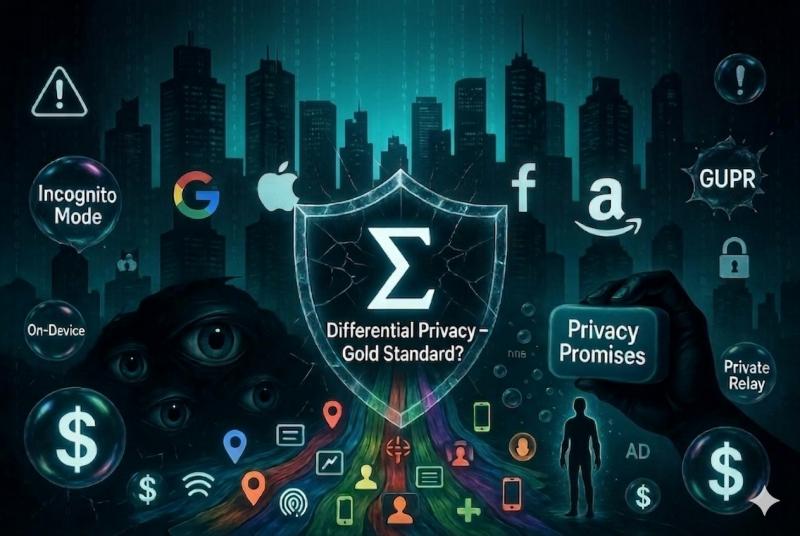
Privacy Washing: How Big Tech's Empty Promises Betray User Trust
This blog dives into the mechanics of privacy washing, in the backdrop of recent instances involving the tech behemoths, and critiques the lax standards that enable it. Drawing from lawsuits, regulatory probes, and expert analyses, we'll see why current privacy frameworks are a patchwork at best—and very far from our essential privacy requirements. The consequences of privacy-washing are threatening for our data, our autonomy, and a future where surveillance isn't optional. In the digital age, privacy has become a buzzword, plastered across ads and privacy policies like a badge of honor. But for Big Tech giants like Google, Apple, Meta, and Amazon, these claims often amount to little more than "privacy washing"—a deceptive marketing tactic that greenwashes surveillance capitalism. Just as oil companies rebrand fossil fuels as "green," these companies tout half-baked features as robust protections while hoarding user data for profit. As of 2025, with global regulations tightening and the rise of consumer awareness, the facade of privacy is cracking. Recent scandals reveal not only the hollowness of these promises but also how privacy conditions fall woefully short of what users deserve: true, enforceable safeguards against exploitation.
What Is Privacy Washing?
The Art of Deceptive Data Defense
It is the ‘skill’ of misleading consumers into thinking their data is secure when companies are actually rebranding surveillance-based business models as privacy-friendly, tricking users with vague controls that benefit the company's data collection. Differential privacy (DP) is considered the "gold standard" for data privacy because it offers a mathematically provable guarantee [1] against re-identification, regardless of an adversary's background knowledge.
It is common for “privacy-first” companies to selectively highlight DP-like formal guarantees to claim a system is entirely "private" or "anonymous," even if the practical application still involves other potential privacy risks or if the chosen parameters allow for significant information leakage. For example,
-
The Privacy Loss Budget (epsilon): This parameter determines the level of privacy protection. A lower epsilon means more privacy and more noise, while a higher epsilon means less privacy and less noise, but greater data utility. Organizations can "privacy wash" by setting a high (less private) epsilon while still claiming to use "differential privacy" as a buzzword.
-
The Noise Mechanism: The specific algorithm used to inject noise (e.g., the Laplace mechanism) requires careful calibration to the sensitivity of the query and the desired privacy loss budget. Improper implementation can lead to privacy bugs or ineffective protection.
-
Data Utility vs. Privacy Trade-off: The noise required for strong privacy can reduce the accuracy and utility of the data for analysis. Hiding the technical details allows companies to prioritize data utility (more accurate results) over true privacy protection, while publicly maintaining a pro-privacy image.
-
Cumulative Privacy Loss: The privacy loss budget erodes with each additional query or analysis run on the data. Managing this budget over time is a complex engineering and policy challenge that requires clear, transparent accounting.
Thus, for DP to be effective and trustworthy, its application must be transparent in terms of all the related parameters, in accordance with Kerchoff’s principle: ensuring robust and auditable security protocols instead of relying on “security by obscurity”. However, there is a significant gap between precisely defined technical privacy models and the flexible, interpretive nature of normative or legal definitions of privacy. Relying solely on the technical definition could be seen as "washing" over the broader societal expectations of what constitutes privacy.
Privacy washing isn't an accident; it's a strategy. Coined by privacy advocates like those at Proton and Tuta, it describes how companies exaggerate or fabricate privacy credentials to appease regulators and users without altering their core business: data extraction. Big Tech's incentive is clear: advertising revenue. Alphabet (Google's parent) raked in $264.59 billion from ads in 2024 alone, per its earnings report, fueling a machine that tracks your every click, location, and query.
Case Study 1: Google's "Incognito" Illusion and Endless Tracking
-
Google, the ad-tracking overlord [2], has mastered privacy washing with tools like Chrome's Incognito mode. Marketed as a shield for private browsing, it promised anonymity from Google's prying eyes. In reality, a 2024 class-action lawsuit exposed it as "effectively a lie." Internal docs revealed Google hoarded billions of Incognito records for ad targeting, leading to a $5 billion settlement in April 2024 where the company agreed to delete the data but only after years of deception.
-
The hits kept coming. In 2025, Google faced a $314.6 million verdict for slurping user data from idle Android phones, even when users weren't interacting, and piping it straight to advertisers. Google is also infamous for the Texas biometric settlement: $1.38 billion for misrepresenting Incognito privacy and tracking locations without consent.
-
Proton's 2024 report [3] calls Google's "Enhanced Ad Privacy" in Chrome a prime offender: It swaps cookies for "Topics" API, still enabling granular targeting under a privacy veneer.
Case Study 2: Apple's "Privacy-First" Facade Crumbles Under Scrutiny
-
Apple positions itself as the privacy champ, with Tim Cook's sermons on data sanctity contrasting its rivals. Yet, 2024-2025 exposed the cracks. Siri, the voice assistant baked into every iPhone, settled a $95 million eavesdropping lawsuit in January 2025. Plaintiffs alleged Apple recorded conversations without permission and shared them with advertisers, effectively violating the very "on-device processing" Apple hypes.
-
iCloud Private Relay, touted as a VPN-like shield, anonymizes IP addresses but leaves browsing habits exposed to Apple and network providers. Apple Intelligence, unveiled in 2024, relies on cloud processing that could leak data, despite "Private Cloud Compute" promises. Ranking Digital Rights gave Apple the highest privacy score in 2025, but internal protests over Gaza-related censorship and biometric data sharing with governments tell a different story. Fines topped $2.1 billion in 2024, per Proton VPN data.
-
Brazil's antitrust body ruled in 2024 that Apple must lift NFC payment restrictions, but a judge paused fines, highlighting how "walled garden" privacy often masks anti-competitive data control. X users decry Apple's Ray-Ban smart glasses as "spyware on your face," turning fashion into surveillance.
Case Study 3: Meta's Ad Empire and Amazon's Silent Surveillance
-
Meta (Facebook, Instagram) wears its privacy washing on its sleeve. In 2024, a $1.4 billion Texas settlement forced Meta to kill its facial recognition tool after unlawfully harvesting biometrics without consent. Yet, it inflated Shops' ad performance by 17-19% to offset Apple's privacy changes, per a 2025 whistleblower, bundling shipping fees into "sales" metrics. The FTC slammed Meta for "vast surveillance" of kids on Facebook and Instagram, collecting data without parental OK. By November 2024, Meta axed opt-outs for AI training data, defaulting users into the pool.
-
Amazon is no saint. A 2025 consumer lawsuit accuses it of backdoor tracking via its Ad SDK in apps, snitching device data without notice. Ring doorbells activated "familiar faces" in 2025, scanning neighborhoods for biometrics in violation of laws like Illinois' BIPA. France fined Amazon in 2024 for micromonitoring warehouse workers, flagging 10-minute breaks as suspicious. EU probes loom over its ad targeting, echoing a 2021 €746 million GDPR fine upheld in 2025.
Why Privacy Conditions Fall Short:
A Regulatory and Ethical Failure
The above cases aren't isolated; they're symptoms of systemic rot in the US privacy laws and regulations. Montana's CDPA kicked in October 2024, but lacks teeth like California's private right of action. No federal baseline means Big Tech lobbies for weak rules, pre-empting GDPR-style overhauls. The EU's DMA hit gatekeepers like Alphabet, Meta, and Amazon in March 2024, but enforcement lags; Meta's "pay-or-consent" model drew 2025 fines for consent coercion.
Globally, data handover rates alarm: From 2014-2024, Google, Apple, and Meta shared user data with U.S. agencies in 80-90% of requests, with FISA content grabs up 2,171% for Google. AI exacerbates this—EU AI Act rules for genAI models start August 2025, mandating risk assessments, but Big Tech's PETs (privacy-enhancing tech) like synthetic data are often window dressing.
Conditions aren't strict because profit trumps people. As Amnesty International's 2025 "Breaking Up With Big Tech" report warns, vertical integrations let them monopolize data flows. Users get opt-outs buried in menus, while defaults feed the beast. True privacy demands end-to-end encryption, data minimization, and audits—not vague policies.
What Now?
Reclaiming Privacy in a Washed-Out World
Privacy washing [4] thrives because we let it. Google's Incognito farce, Apple's Siri snooping, Meta's ad inflation, and Amazon's Ring spying show Big Tech's "protections" are profit shields, not user armor. With 2025 bringing eight new U.S. state laws and AI regs, the tide could turn—but only if we demand more.
Use privacy-focused tools like Proton Mail or Tuta [5] for email, enable full-disk encryption, and support federal bills like the APRA. Advocate for bans on non-consensual biometrics and real-time bidding auctions that leak data. As X user @wslyvh laments, "Big-tech continues to hoard our data and personal lives." Let's not let them.
Big tech won't self-regulate; their $ trillions say otherwise. But armed with knowledge, we can wash away the deception. Privacy isn't a feature—it's a fortress. Let's fortify it before the next "update" slips through the cracks.
Edited By: Windhya Rankothge, PhD, Canadian Institute for Cybersecurity
References
[1] Cynthia Dwork, Frank McSherry, Kobbi Nissim and Adam Smith. “Calibrating Noise to Sensitivity in Private Data Analysis”. Theory of Cryptography (TCC), 2006, https://link.springer.com/chapter/10.1007/11681878_14
[2] A. M. Cirucci. “Oversharing the super safe stuff: 'Privacy-washing’ in Apple iPhone and Google Pixel commercials”. First Monday, 2024, https://firstmonday.org/ojs/index.php/fm/article/view/13321
[3] Proton. “The worst privacy washing of 2023 and trends to expect in 2024”. January 2024, https://proton.me/blog/privacy-washing-2023
[4] Privacy Guides. “Privacy Washing Is a Dirty Business”. August 2025, https://www.privacyguides.org/articles/2025/08/20/privacy-washing-is-a-dirty-business/
[5] Tuta. “Privacy washing: How Tech Giants sell you trust, but mine your data.” August 2022, https://tuta.com/blog/big-tech-privacy-washing